


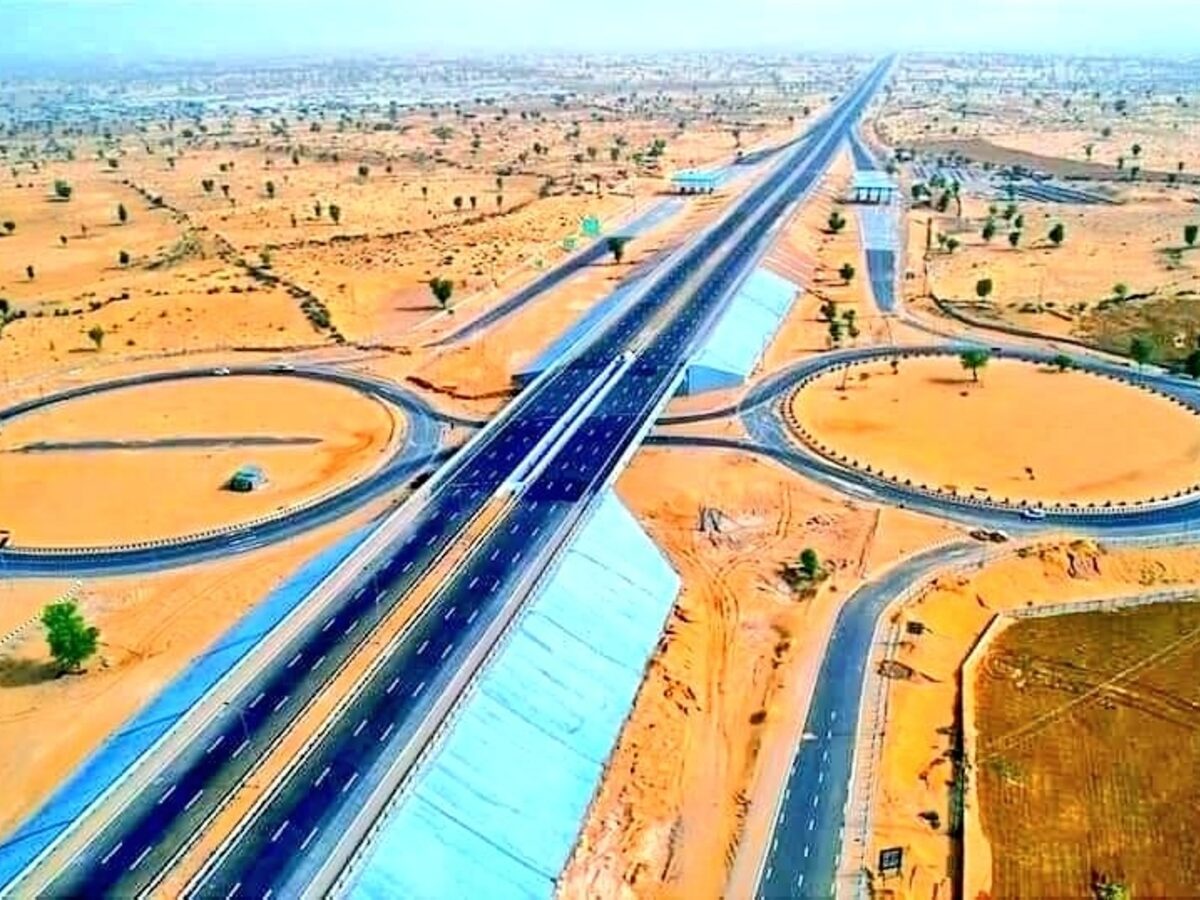
Rajasthan’s Churu district is poised for a transformative leap in connectivity and development with its inclusion in the Amritsar-Jamnagar Expressway—one of India’s most ambitious greenfield highway projects under the Bharatmala Pariyojana.
This strategic move links Churu directly to a 917-kilometre high-speed corridor that weaves through Punjab, Haryana, Rajasthan, and Gujarat, paving the way for unprecedented economic and infrastructural growth in this semi-arid region of northwestern India. Often regarded as the “Gateway to the Thar Desert,” Churu has historically remained peripheral to the national logistics and tourism networks due to limited road infrastructure and underdeveloped transport systems. Its new role along the six-lane expressway radically changes this reality. By integrating Churu into a pan-regional mobility framework, the corridor reduces freight movement delays, trims transportation costs, and ensures more efficient access to India’s central and western ports. For an economy driven by agriculture, livestock, and handicrafts, this is a pivotal shift—creating linkages that were previously stifled by geographical isolation.
The expressway, with an expected completion timeline stretching to the end of 2025, is more than just a transport corridor; it is a developmental artery. The route’s realignment through Churu not only supports agrarian and artisanal output but also creates a more inclusive supply chain ecosystem that ties rural producers to national demand centres. This reduced dependency on intermediary routes means better price realisation for local communities and expanded access to raw materials and markets, bringing equity to regional trade flows.
On the tourism front, Churu’s inclusion is equally momentous. Its rich heritage—manifested in fresco-laden havelis, desert vistas, and folk traditions—has long held untapped potential. The expressway significantly cuts travel time from major metros, thus unlocking a new demographic of weekend and circuit tourists. This logistical ease is expected to spark growth in local hospitality enterprises, bolster cultural tourism circuits, and create employment opportunities across ancillary sectors, thereby uplifting the region’s service economy.
This stretch of the expressway through Rajasthan notably traverses over 650 kilometres of the Thar Desert, serving as a connective spine for relatively underdeveloped districts such as Bikaner, Barmer, Jalore, and now Churu. It represents a vital infrastructural shift that embeds previously disconnected rural clusters into the national growth narrative. By doing so, the project aligns with the broader national goals of building equitable and sustainable urban-rural linkages, reducing carbon-intensive supply chains, and promoting decentralised development.
With the Bharatmala Project adopting a climate-sensitive and future-ready approach to infrastructure development, the Churu extension highlights how transport corridors can be engines for sustainable progress, especially in ecologically sensitive zones. As the state government is expected to propose new tourism and economic circuits centred around this improved access, the emphasis remains on maximising local value generation while balancing environmental sustainability. In a region where opportunity has often been dictated by connectivity, the expressway emerges as a timely catalyst for inclusion, resilience, and prosperity.
Also Read :https://livzzy.in/bihar-to-develop-buxar-bhagalpur-expressway-with-dpr-in-progress/